|
|









November 27, 2026
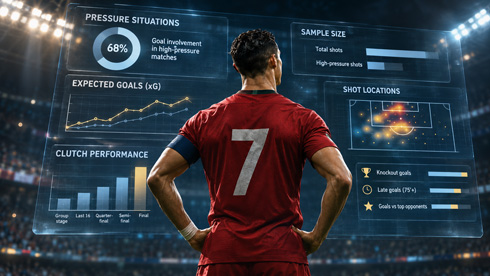
Modern football analytics is changing how we evaluate Cristiano Ronaldo, Lionel Messi and the game's greatest players. Beyond traditional goals and assists, advanced metrics such as expected goals, opponent strength and match-state analysis offer a deeper understanding of individual performances, competitive pressure and what truly separates exceptional footballers from their rivals.
The easiest thing to measure in football is what happened. The hardest is deciding how much it mattered, regardless of the moment you decide to do it. A striker scoring the fourth goal in a 5-0 win receives exactly one goal in the record books. So does the player who turns a UEFA Champions League tie in the 88th minute. Cristiano Ronaldo has been in that role many times... Nobody watching those moments believes they are equivalent, yet traditional statistics largely treat them as though they are...
Cristiano Ronaldo's stats and achievements in 🏴. https://t.co/mSs6g2jNIL
— TCR. (@TeamCRonaldo) August 26, 2021
That is why the idea of the “clutch” footballer has survived the analytics revolution rather than being killed by it. Analysts now have more tools for separating volume from consequence, looking beyond goals and assists towards match state, expected goals, opponent strength, knockout rounds and how much a particular action changes a team’s chances of winning. The same underlying information increasingly feeds broadcasts, recruitment models and prices offered by the best online betting sites uk. But the interesting question remains stubbornly human: does a player actually become better when the pressure rises, or do we simply remember the occasions when brilliance and importance happened to meet?
Cristiano Ronaldo is almost designed for this argument. His career contains too many dramatic examples to ignore: the hat-trick against Wolfsburg when Real Madrid needed to overturn a two-goal Champions League deficit, the three goals against Atlético Madrid in the following season’s semi-final, Portugal’s World Cup play-off against Sweden and countless late interventions. A detailed attempt at measuring Ronaldo’s performances in big games was already trying to solve the problem years ago by defining important matches first and then comparing his scoring consistency within them.
Modern analysis can go further. One method is to weight actions according to match state. A goal scored at 0-0 should generally carry more competitive significance than one scored when a team already leads 4-0. A goal in the final ten minutes of a tied knockout match can be given more value again because there is less time for the opponent to recover. Analysts can also measure whether a player maintains his expected-goal output, chance creation or ball progression against stronger opponents rather than merely accumulating impressive totals against weaker sides.
This sounds like the moment when mathematics finally proves who is clutch.
It probably does not.
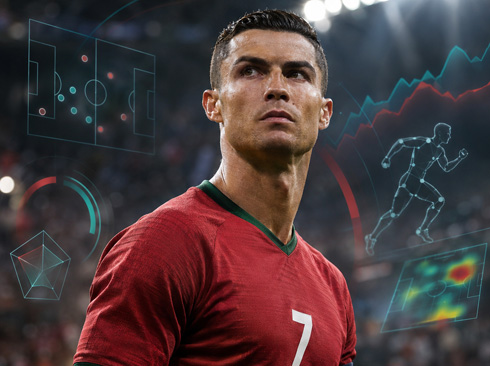
Football creates a basic sample-size problem. Truly enormous moments are rare. A player may take hundreds of shots in a season but perhaps only a handful arrive in circumstances we would confidently describe as extreme pressure. If he scores three of them, we begin constructing a personality around the result. If he misses three, the same process works in reverse. Suddenly one player “loves the big occasion” while another “disappears when it matters”, even when the evidence is based on remarkably few events.
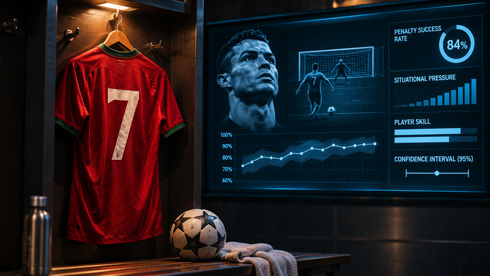
Penalty kicks offer a useful glimpse of how complicated pressure can be. Research into skill, pressure and penalty success analysed 1,711 penalties from major international tournaments and found that high situational pressure increased the probability of missing the target, while higher player skill helped protect against some of that effect. That is much more interesting than saying good players simply have stronger nerves. Pressure appears to matter, but so does the quality of the person experiencing it.
Analytics therefore has to distinguish clutch performance from ordinary excellence. Lionel Messi creating three chances in a Champions League semi-final is still playing brilliantly even if none becomes a goal. A goalkeeper making six saves while trailing 3-0 may have performed superbly without changing the result. Likewise, a striker can score a late winner after doing almost nothing for 89 minutes. The scoreboard remembers the striker. A serious model should remember both.
There is another difficulty: opportunity itself is unequal. Great players at great clubs appear in more finals, knockout matches and title races. They therefore receive more chances to manufacture defining moments. Ronaldo’s remarkable collection of Champions League performances is evidence of his quality, but also of the fact that Real Madrid kept reaching the stages where such performances could become legendary. Context does not diminish the achievement; it simply stops the numbers becoming mythology.
Perhaps that is where sports analytics is most useful. It cannot produce a definitive “clutch rating” that settles every pub argument. What it can do is make the argument more demanding. How strong was the opponent? What was the score? How much time remained? What was the quality of the chance? Did the player’s performance actually improve under pressure, or did one unforgettable goal overwhelm everything else we saw?
The numbers will never remove the romance from decisive football moments. Nor should they.
They simply remind us that scoring when everybody is watching is impressive.
Doing it repeatedly, against strong opponents, when the match genuinely hangs on the next action, is something rather harder to fake.
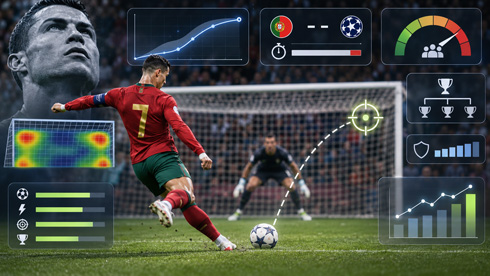
Cristiano Ronaldo next game for Al Nassr is on November 28, against Al Hazm, for the Saudi Pro League. You can watch Al Hazm vs Al Nassr, Real Madrid vs Alaves, Deportivo vs Barcelona, Manchester United v Brentford, Nottingham Forest vs Chelsea and Ipswich Town vs Aston Villa, all matches provided from our football live streaming game pages.
Al Nassr next game:
Al Hazm vs Al Nassr kick-off time (28-11-2026):
Beijing (China) | UTC/GMT+8: 03:00
India (New Delhi) | UTC/GMT+5.30: 00:30
Saudi Arabia (Riyadh) | UTC/GMT+4: 23:00
Spain (Madrid) | UTC/GMT+2: 21:00
Portugal and England (Lisbon/London) | UTC/GMT+1: 20:00
Rio de Janeiro (Brazil) | UTC/GMT-3: 16:00
New York (United States) | UTC/GMT-4: 15:00
Los Angeles (United States) | UTC/GMT-7: 12:00
Sources: ronaldo7.net / apnews.com / sciencedirect.com