|
|









August 13, 2026
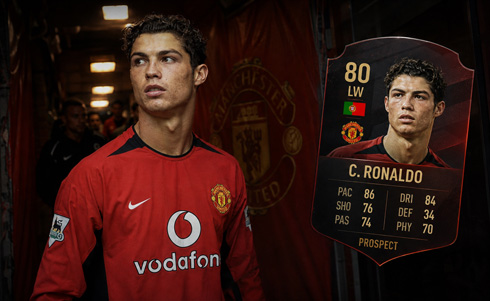
Ronaldo has been one of the defining players in FIFA and EA Sports FC history, evolving from an 80-rated Manchester United prospect into an Ultimate Team superstar. His ratings, special cards and virtual legacy have closely mirrored a remarkable real-world career spanning more than two decades.
When Ronaldo arrived at Manchester United in the summer of 2003 as the most expensive teenager in English football history, EA Sports gave him an 80 overall rating. It was modest, cautious, appropriate for an 18-year-old whose potential was obvious, but whose peak was still years away. What followed over the next two decades was one of the most remarkable rating trajectories in the history of the franchise – and a commercial and cultural relationship between a real-world footballer and a video game series that has never quite been replicated.
Cristiano Ronaldo on the cover of EA sports 24. 😍 pic.twitter.com/u6Pfeikcuw
— TCR. (@TeamCRonaldo) October 18, 2023
Ronaldo's first FIFA card tucked him in among Manchester United's substitutes. His 80 rating placed him below Rio Ferdinand, Roy Keane, Paul Scholes, Ryan Giggs, and Ruud van Nistelrooy in the Old Trafford pecking order – which, in the context of that squad, was entirely reasonable. EA Sports' early face scans were rudimentary enough that the virtual Ronaldo bore only a passing resemblance to the real one, but the raw athletic attributes were already there: pace, dribbling, and a shooting profile that hinted at what was coming.
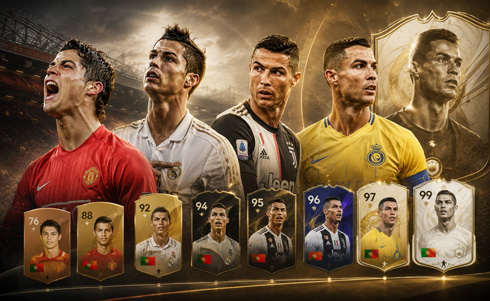
By FIFA 05, he had jumped to 88, and the ascent continued steadily through the late 2000s. His rating sat at 91 across FIFA 06, FIFA 08, and FIFA 09 – a level that recognised his elite status without yet placing him at the summit. Even a then-world-record £80m move to Real Madrid in 2009 didn't immediately shift the numbers in his favour, with his rating dipping to 89 in FIFA 10 before climbing again as his Real Madrid years produced Ballon d'Or after Ballon d'Or. By FIFA 16, he had reached 94 – a base card rating he held across four consecutive editions through FIFA 19, jointly the highest in the game alongside Messi for much of that stretch.
FIFA Ultimate Team launched properly in FIFA 10, and Ronaldo's first FUT card carried a 93 overall – immediately establishing him as one of the most coveted players in the mode. Over the years that followed, the relationship between CR7 and FUT became something the franchise built entire promotional cycles around. Special edition cards arrived regularly: Team of the Year versions with ratings reaching 99, FUT Birthday editions with enhanced attributes, and In-Form cards that reflected his real-world performances week by week.
By the time the franchise reached its later editions, Ronaldo had accumulated 134 cards across FUT – across seven different clubs, in two different positions. The range of those cards reflected his career's own geography: Manchester United's red, Real Madrid's white, Juventus's black and white stripes, Al Nassr's yellow. Each club move produced a new card, and with each new card came a new wave of community discussion about attributes, pace ratings, and whether the virtual version matched the real one fairly.
The highest-rated Ronaldo card ever produced carried a 99 overall – achieved through special editions rather than his base card rating, which peaked at 94. Getting one required either an enormous investment of in-game currency or the kind of luck that made opening packs genuinely exciting for millions of players. The desirability of a Ronaldo special edition card wasn't just about his in-game stats – it was about what owning one said about your team, your investment in the mode, and your understanding of the game's hierarchy.
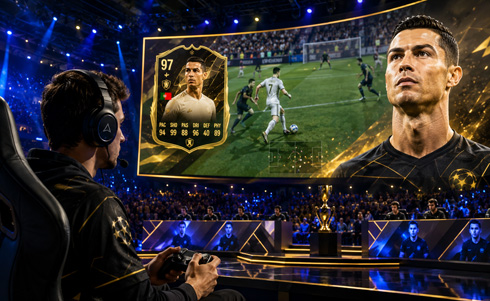
The FIFA franchise – now rebranded as EA Sports FC following the split with FIFA's governing body – has developed its own competitive esports ecosystem that runs parallel to the real-world football it simulates. The EA Sports FC Pro series operates across regional leagues in Europe, with national team competitions and a global final that attracts the game's best players. The competitive meta in any given edition is shaped substantially by which players are considered elite – and for most of the franchise's competitive history, Ronaldo has been part of that conversation.
For anyone following the competitive side of the game, FIFA esports betting markets cover eFootball and EA Sports FC competitive events – the same virtual football ecosystem that Ronaldo's digital presence has helped define. The players who dominate competitive FUT aren't always using the same cards that casual players aspire to, but the principle is identical: team construction, player attributes, and understanding which cards give a competitive edge at a given moment. Ronaldo's place in that conversation – whether as a base card, a special edition, or an Icon – has been a constant reference point for how the community thinks about what makes a virtual footballer genuinely valuable.
It’s also players like him that have made this game glamorous, driving up interest in FIFA esports betting as a whole. When footballers are this elite, they attract attention, heighten excitement, and maximize engagement, and that in turn brings more players to the game. His fandom is international, and it has helped drive overall interest in digital versions of the pitch. As more people have joined the game and more people have begun to play it competitively, interest in esports betting has risen sharply, for the exact same reasons it’s popular in physical football: it enhances the audience’s engagement in the match and boosts their enjoyment too.
One of FUT's most significant innovations was the introduction of Icon cards – special versions of legendary retired or semi-retired players that allowed fans to field historical versions of their heroes, regardless of club affiliation. The Icon system created a new category of desirability that transcended current form: prime versions of players at their absolute peak, rated to reflect not their current ability but the greatest period of their career.
Ronaldo's Icon potential has been a subject of community discussion for years. His continued active playing career at Al Nassr has kept him in the base card pool rather than transitioning to Icon status, but his future as an Icon once he retires is considered one of the most anticipated additions the mode could receive. A prime CR7 Icon, rated to reflect his Real Madrid peak, would represent the convergence of two decades of virtual football history into a single card.
What makes Ronaldo's relationship with the FIFA franchise so durable isn't just that he's been one of the best players in the world for two decades. It's that his qualities – elite pace in his prime, finishing, heading ability, five-star skill moves – translate exceptionally well into the game's mechanical framework. A footballer whose real-world strengths involve attributes that the game actively quantifies and rewards will always feel right in the virtual version. When you build a team around Ronaldo in FUT, you know exactly what you're getting and why it works.
That clarity is rare. Some elite real-world players don't translate cleanly to the game's systems – their qualities are too contextual, too dependent on off-ball movement or leadership that a rating system struggles to capture. Ronaldo's game has always been legible: he scores, he's physically dominant, he takes free kicks. Those qualities were quantifiable in FIFA 04, and they're quantifiable now. The rating has changed. The reason to want him on your team hasn't.
Cristiano Ronaldo next game for Al Nassr is on August 16, against Al Diriyah, for the King's Cup. You can watch Al Diriyah vs Al Nassr, Schalke vs Real Madrid, Barça vs Al Ahly, Manchester United vs AC Milan, Arsenal vs Manchester City and Chelsea vs Real Sociedad, all matches provided from our football live game pages.
Al Nassr next game:
Al Nassr vs Al Diriyah kick-off time (16-08-2026):
Beijing (China) | UTC/GMT+8: 03:00
India (New Delhi) | UTC/GMT+5.30: 00:30
Saudi Arabia (Riyadh) | UTC/GMT+4: 23:00
Spain (Madrid) | UTC/GMT+2: 21:00
Portugal and England (Lisbon/London) | UTC/GMT+1: 20:00
Rio de Janeiro (Brazil) | UTC/GMT-3: 16:00
New York (United States) | UTC/GMT-4: 15:00
Los Angeles (United States) | UTC/GMT-7: 12:00
Sources: ronaldo7.net / 90min.com / fifa.com